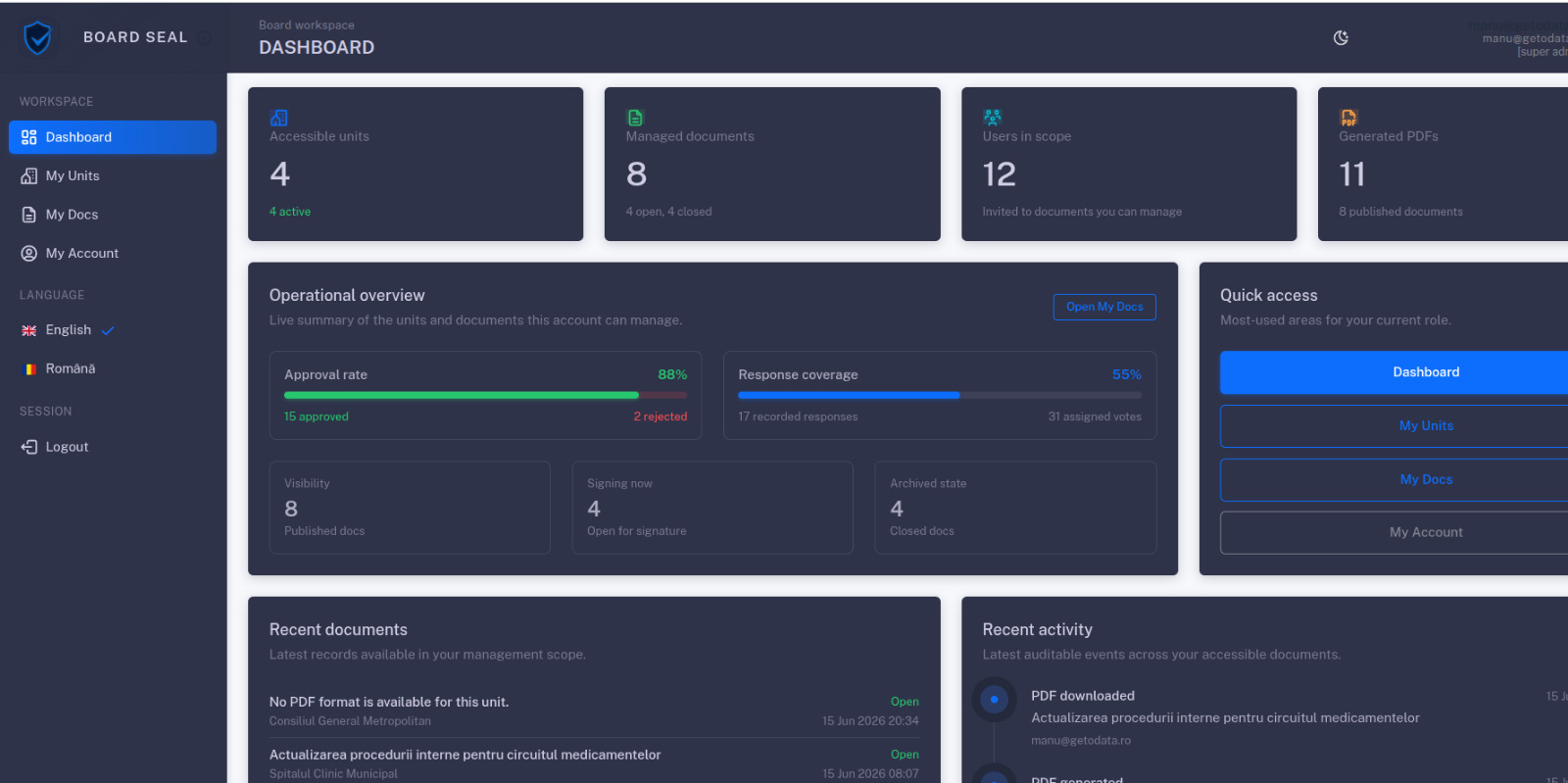
BoardSeal manages the complete lifecycle of board documents — from composition to sealed PDF verification — in a single, auditable, unit-scoped platform.
BoardSeal is a controlled document management platform built for organisations that need traceable, auditable workflows around board decisions.
The platform is intentionally restrictive: no document can be altered once voting begins, no PDF can be overwritten once sealed, and no action goes unlogged.
Every organisational unit operates as an independent namespace. Documents, members, PDF renderers, and settings belong to a unit and are inaccessible outside it.
Documents carry a controlled set of fields: title, registration number, publication date, body text, structured decision lines, and an explicit list of allowed signers.
Opening a document for voting locks all content edits. Each assigned member casts exactly one vote — approve or reject. Suspension and resumption are available to moderators throughout.
PDFs are produced through versioned renderers assigned per unit. Each generation creates an immutable snapshot stored alongside a SHA-256 fingerprint — re-generation is additive, never destructive.
Every meaningful action — creation, publication, state changes, PDF generation, downloads, and verification checks — is written to a permanent, append-only event log with timestamps and IP addresses.
A UUID-based verification endpoint lets any stakeholder confirm document integrity by comparing the live SHA-256 hash against the stored fingerprint — no account required.
Each capability closes a specific gap in the management chain — from authorisation through to sealed output.
Named organisational units with logo, contact info, and member affiliation. Each unit is independent and isolated at every layer.
Structured documents with decision lines, signer scoping, voting state machine, and format versioning — built for board-level management.
Per-user approval and rejection with content lock-down during active voting. Full tally and progress visible in real time.
Versioned renderers produce immutable PDF snapshots with SHA-256 fingerprints. Re-generation is always additive, never destructive.
Every state transition and document action is captured in an append-only event log with timestamps and originating IP addresses.
UUID-based public verification pages compare live hash values against stored fingerprints — no account required for external stakeholders.
The operational sequence is intentionally strict. Each phase closes before the next opens. No action is permitted out of order.
Activate the organisational unit, configure branding and contact information, assign moderators, and affiliate the member accounts that will participate in voting.
A moderator fills in the registration number, dates, body text, structured decision lines, the list of allowed signers, and the PDF renderer to be used for final generation.
Publishing locks all content edits and makes the document visible exclusively to assigned members. Only voting state controls (suspend / resume) remain available to the moderator.
Each assigned member reviews the document and submits an approval or rejection. Progress is visible in real time. Each vote is immutable once submitted.
The moderator triggers generation. The selected renderer produces the PDF, which is stored as an immutable snapshot and fingerprinted with SHA-256. The hash is permanently linked to the document record.
The public verification page accepts the document UUID and performs a live hash comparison. The result — intact or altered — is returned without exposing raw file content or member data.
Security is embedded in the authentication model, data access rules, document state machine, and generated outputs — not added as a surface feature.
| Ref. | Control | Layer | Description | Active |
|---|---|---|---|---|
| S-01 | SHA-256 integrity hashing | System | Every PDF snapshot is fingerprinted at generation time. The hash is stored separately and recalculated on every verification request to detect any modification. | |
| S-02 | Two-factor authentication | User | TOTP-based 2FA with backup codes for all user accounts. The 2FA session is independent of the primary credential and required separately on each login. | |
| S-03 | Role-based access control | System | Operators, moderators, and administrators hold scoped permissions. Document access is further restricted by unit affiliation and explicit allowed-signer assignment. | |
| S-04 | Immutable audit log | System | Audit events are append-only. No entry can be modified or deleted through the application layer. Every event captures a timestamp and originating IP address. | |
| S-05 | Email verification | Auth | All accounts require email confirmation before activation. Invitation tokens are time-limited and single-use. Password-set links follow the same token model. | |
| S-06 | Content lock-down on publication | System | Publishing freezes all content fields for all roles. No moderator or administrator can alter body text, decision lines, or signer lists once the document enters an open or closed voting state. | |
| S-07 | Scoped public access | System | Public verification endpoints expose only the hash comparison result and non-sensitive metadata. Raw PDF content and member data are never accessible through public routes. |
Direct answers to the questions most frequently raised when evaluating the platform.
Sign in to access your documents, or open the dashboard to manage units and the complete document lifecycle.